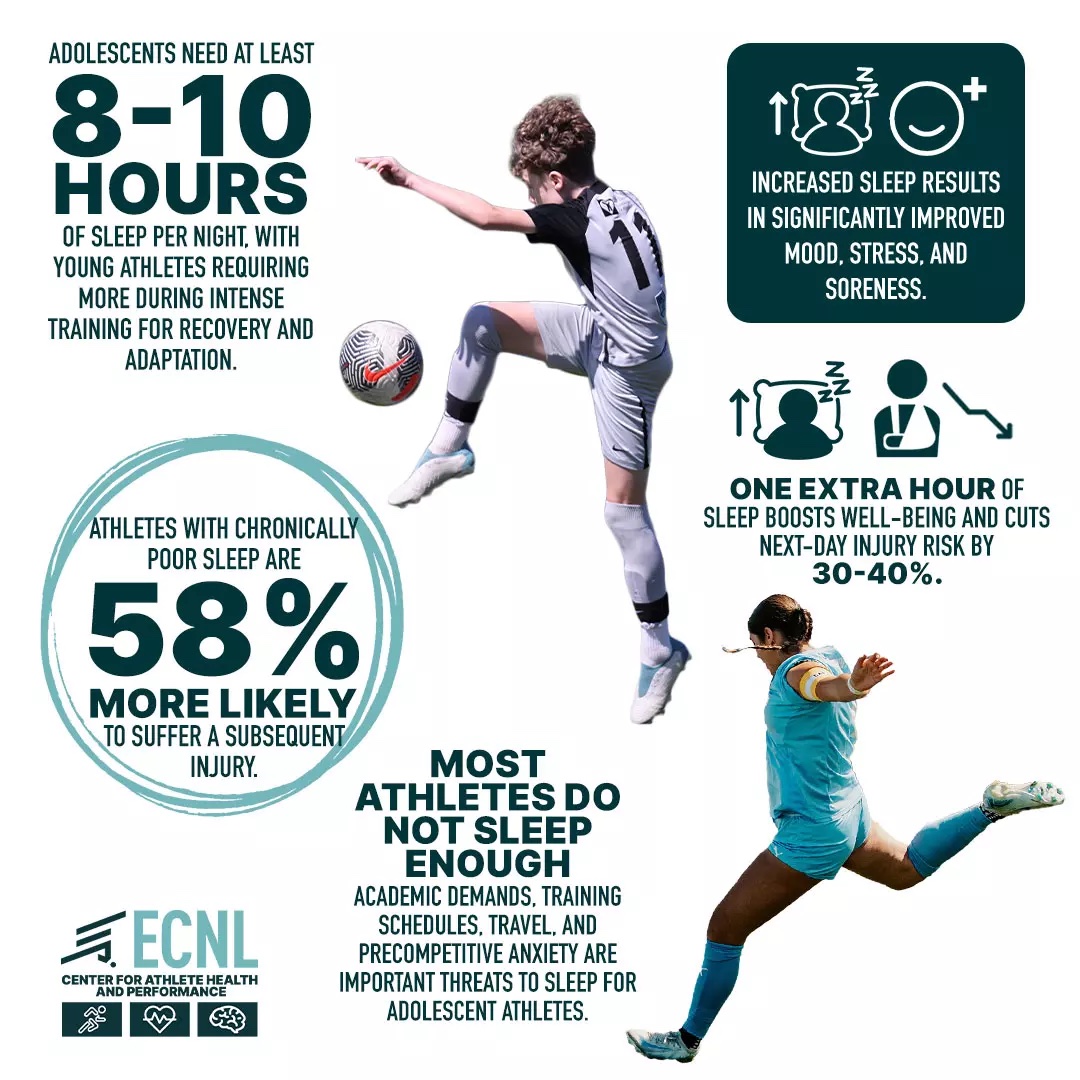


RICHMOND, VA – The ECNL Center for Athlete Health and Performance, led by ECNL Chief Medical Advisor Dr. Drew Watson, published results from a nationwide survey of ECNL athletes that found sleep was the strongest predictor of mental health and quality of life.
As part of a larger ongoing effort to understand the predictors of psychosocial outcomes among elite youth soccer players, the ECNL Center for Athlete Health and Performance conducted a nationwide survey of more than 660 ECNL athletes regarding mental health, quality of life, and a broad range of potential predictors, including age, gender, race/ethnicity, sleep, athletic identity, match volume, and prior injury. When all of these predictors were evaluated together, however, the single strongest predictor of better mental health and higher quality of life was increased sleep. In addition, while boys reported higher levels of total quality of life and psychosocial health than girls, the majority of this difference was due to the fact that boys reported greater sleep than girls.
“Organized sports have been repeatedly shown to have significant mental health benefits for athletes,” Dr. Watson said. “In addition to the inherent benefit of improved mental health, higher levels of athlete well-being are associated with improved performance, reduced injury risk and reduced illness risk. Identifying the factors that are associated with positive and negative psychosocial outcomes is a vital first step to understanding how to help young athletes on and off the field.”
The ECNL Center for Athlete Health and Performance has also previously shown that improved sleep is associated with a reduced risk of injury and a broad range of improved performance outcomes in young athletes. These new findings further advances the understanding of this relationship between sleep and well-being, highlighting the strong and independent relationship that increased sleep has with mental health and quality of life. This suggests that improved sleep among young athletes, whether through individual-level interventions or system-level programming, can have significant positive impacts on mental health, performance, and injury risk.
The ECNL Center for Athlete Health and Performance launched in March 2025 to identify, develop and share best practices in long-term youth athlete health, development and performance. The ECNL Center for Athlete Health and Performance provides compilations of the most applicable research from around the world on topics relevant to youth athletes, as well as evidence derived from research projects within the ECNL conducted in collaboration with Dr. Watson’s Human Performance Laboratory at the University of Wisconsin.
The CAHP will continue to conduct research, disseminate evidence, and offer recommendations on a wide range of high-yield topics relevant to youth athletes, coaches, and families, including mental health, injury and illness risk and prevention, load management, pediatric exercise physiology, sport nutrition, and more.
For more information regarding the ECNL Center for Athlete Health and Performance, click here.